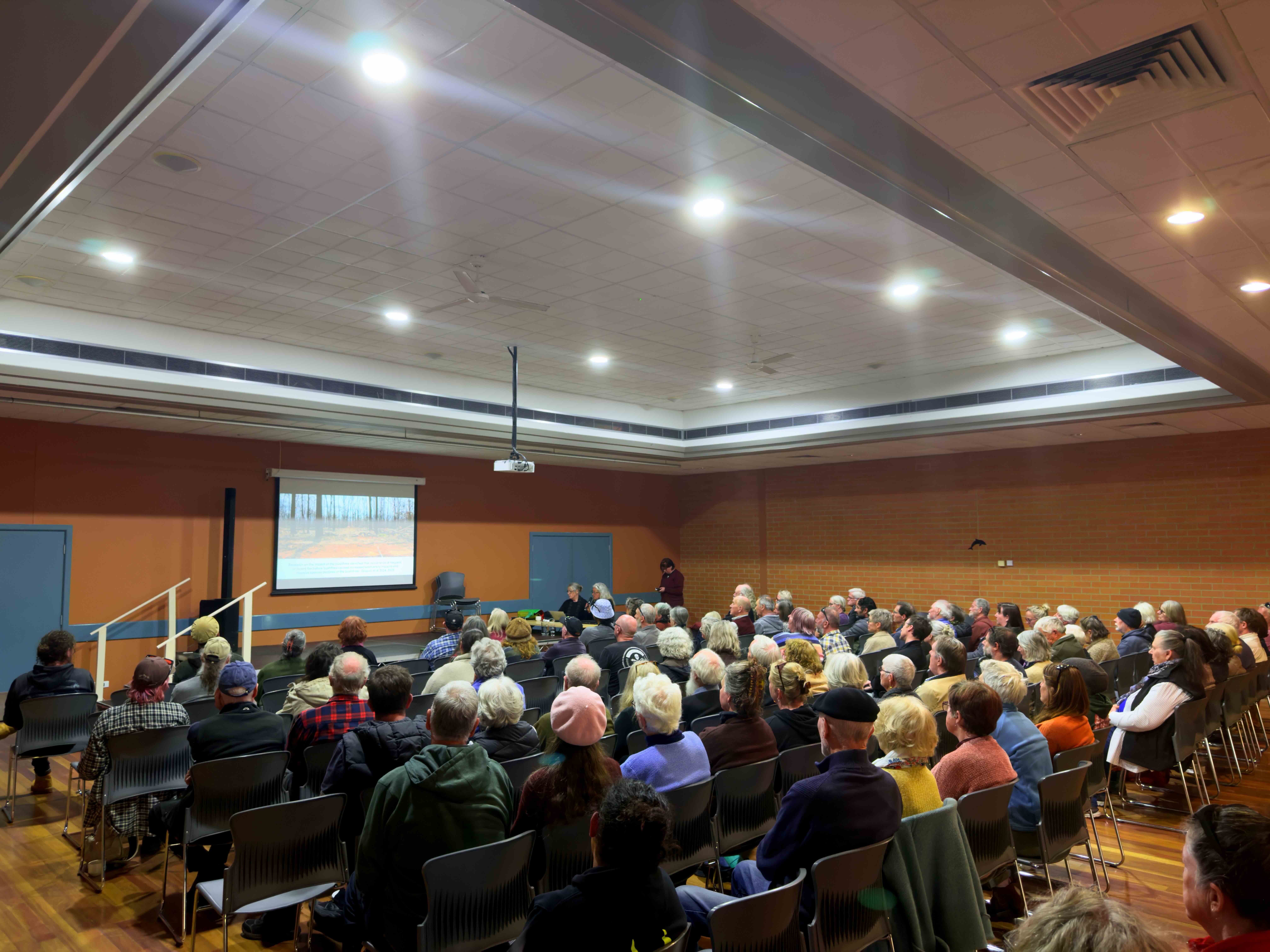
More than 80 people came to the Mechanics Hall in Lakes Entrance on Saturday 15 August to hear fire behaviour scientist Dr Philip Zylstra take apart one of the most repeated ideas in Australian fire management: that the weight of leaf litter on the forest floor is what makes a bushfire dangerous.
Dr Zylstra is an Adjunct Associate Professor at Curtin University and a former remote area firefighter. He traced the idea of "fuel load" back to pine forestry in the United States in the 1950s, and showed why the model has never held up when researchers have tested it.
"You are not allowed on a fire ground unless you can recite that scripture. Double the fuel load, double the rate of spread."
He also explained what repeated burning actually does to a forest. A burn strips the ground bare, which lowers fire risk briefly, but what grows back is dense regrowth that carries fire from the ground into the canopy. That effect lasts for decades.
"We may be the cause of the problem, not the cure."
Rethinking Planned Burns was presented by the Goongerah Environment Centre, the Gippsland Environment Group and Environment East Gippsland, with the support of Patagonia and the Victorian Forest Alliance. The afternoon started with a Welcome to Country by Gunaikurnai elder Marjorie Thorpe, followed by a presentation of local monitoring findings from the Gippsland Environment Group, a screening of Forest Country by filmmaker Lewi Haskins, and a panel Q&A.
Take action
Victoria's forests are being burnt on the basis of a theory the evidence does not support, while the resources that actually protect communities go underfunded. Join the Victorians for Nature campaign and help make nature an issue at this state election.